

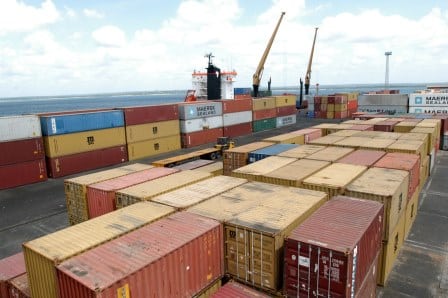
The Mozambican government has authorized an international tender to drive the integrated expansion and development of the Port of Nacala in Nampula province, a move expected to significantly enhance the country’s transport and logistics capabilities. Approved by the Council of Ministers in Maputo, the resolution empowers the Ministry of Transport and Logistics to oversee the tender process for the port’s modernization and capacity expansion.
Currently, the Port of Nacala, a key hub within the Nacala Logistics Corridor, handles approximately 3.5 million tonnes of cargo annually, representing just 35% of its total 10 million tonnes capacity. The port’s infrastructure includes a modern container terminal capable of processing 252,000 containers per year, a general cargo terminal with a 2.4 million tonnes annual capacity, and a liquid terminal that can handle 3.6 million tonnes. Its navigable channel, over 18 metres deep, removes the need for constant dredging, providing an operational advantage for shipping and logistics companies.
Despite these features, government officials say improvements are needed to ensure unrestricted operations and to fully leverage the port’s potential. The integrated development project aims to optimise terminal operations, establish a special economic zone, construct dry ports to attract foreign investment, and build a floating dry dock and repair facilities. These measures are expected to improve the efficiency and competitiveness of the port while supporting the growth of regional trade.
The Nacala Logistics Corridor, operational since 2016, links the deep-water port to a 912-kilometre railway primarily used for coal exports from Tete province. The corridor was developed through a $4.5 billion investment involving Brazil’s Vale, Japanese conglomerate Mitsui, and Mozambique’s public ports and rail company, CFM. The corridor not only facilitates the movement of goods but also serves as a critical trade link for landlocked nations such as Malawi and Zambia.
President Daniel Chapo has highlighted the strategic importance of the corridor, describing it as an axis with significant potential for sustainable agriculture, industrial parks, and regional trade promotion. The port and corridor are central to Mozambique’s broader transport and logistics strategy, supporting both domestic economic growth and international trade.
In addition to Nacala, the government has established a project implementation office for the Beira Development Corridor in central Mozambique. This office will coordinate strategic transport projects, including the construction of the access road to Beira port, a dry port in Dondo district, and one-stop border posts at Machipanda and Massacatiza. The initiative aims to reduce bureaucratic delays, facilitate project execution, and strengthen Mozambique’s overall logistics network.
Mozambique’s efforts to expand and modernise its port infrastructure reflect the government’s commitment to positioning the country as a regional logistics hub. By improving efficiency, attracting foreign investment, and strengthening trade links with neighbouring countries, the country is set to enhance both its transport sector and broader economic development.
