



Mercedes-Benz Trucks Classic is kicking off the anniversary year “130 Years Trucks” at Retro Classics Stuttgart, which will take place from February 19 to 22, 2026. Alongside partners such as IG Süd, a group devoted to historic commercial vehicles, an active community of classic truck fans from southern Germany, and Konrad Auwärter, a respected authority and guardian of German bus history, the brand offers a remarkable exploration of truck and bus heritage. The Mercedes-Benz Trucks exhibit spans 700 square meters. The trade fair is projected to attract about 70,000 attendees.
Retro Classics 2026: Mercedes‑Benz Trucks Classic Launches Anniversary Year “130 Years Trucks” with the World’s First Truck
“130 years of trucks signifies 130 years of innovation and pioneering spirit. We can be proud of our achievements while this anniversary encourages us to move forward. At Mercedes-Benz Trucks, tradition and the future are fundamentally interconnected, just as our unwavering commitment to our customers and top-quality service remains. This commitment encompasses forward-thinking and continuously developing transportation solutions that bring value to our customers,” states Jean-Marc Diss, Head of Global Sales & Marketing, Mercedes-Benz Trucks.
The centerpiece at the display in Hall 10 is the recreation of the world’s first motorized truck, which was presented by Gottlieb Daimler in 1896. The two-cylinder “Phoenix” engine, mounted at the rear, produces four horsepower with a displacement of 1.06 liters and drives the rear axle using a belt system. To shield the delicate engine from vibrations, coil springs are utilized, and the front axle is steered via chains. The driver is seated on a raised coach-style bench, while the engine is located at the back. Notably, Daimler had already incorporated a principle still in use today in heavy-duty trucks: the planetary hub-reduction axle.

In 1898, the next evolutionary advancement was made: the engine was relocated beneath the driver’s seat and eventually moved further forward, ahead of the front axle, a configuration that allowed for enhanced performance and increased payload capability. Daimler validated the vehicles in real-world settings at a brickworks before commencing series production. This signified the start of a success story that transformed international transport. By 1899, Daimler had delivered the inaugural trucks to England and France, where they triumphed over steam-powered vehicles.
The global significance of these vehicles was apparent early on: at the 1900 World Exhibition in Paris, Daimler showcased its vehicles to an international audience. As early as 1898, the company ventured into the US market by establishing the Daimler Manufacturing Company in Long Island City, New York, thereby creating a worldwide presence at the dawn of the century, a legacy that endures to this day.

Three Decades of Actros – The Start of the Modern Truck Generation
Since 1996, the Mercedes-Benz Actros has represented the transformation from a conventional commercial vehicle to a sophisticated, electronically interconnected working tool. At Retro Classics 2026, Mercedes-Benz Trucks Classic is highlighting the first generation of the Actros—three decades after its debut at the IAA.
The Actros signifies a crucial technological advancement: it was the brand’s inaugural heavy-duty truck featuring a CAN data bus, electronically controlled braking systems, integrated safety assistance systems, and the innovative MegaSpace cab.


In 1996, Mercedes-Benz established new benchmarks in efficiency, safety, and driver comfort with the release of the Actros. Another significant milestone occurred in 2006 with the introduction of Active Brake Assist—another system that will celebrate its anniversary in 2026. As a trailblazer in assistance technology, Active Brake Assist has undergone continuous upgrades and remains pivotal in enhancing active safety on the roads.
Currently, the Actros lineup encompasses several generations, including the latest Actros L and the eActros 600. Together, they exemplify three decades of technological advancements—from new drivetrain technologies and interconnected systems to extensive safety features. This development reflects the vital role the Actros plays in modernizing freight transportation and its profound connection to 130 years of innovation in truck development.
Safety Truck Based on the Mercedes-Benz eActros 600
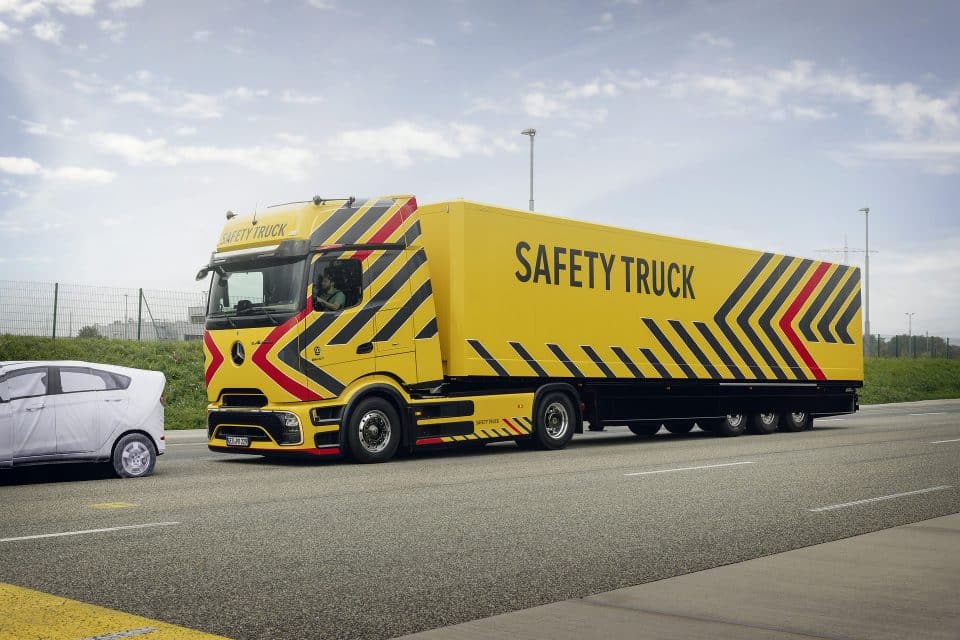
Mercedes-Benz Safety Truck with Active Brake Assist 6 with pedestrian recognition and active braking
With the introduction of the new Safety Truck derived from the eActros 600, Mercedes-Benz Trucks showcases the progress made in safety technology over 130 years of truck evolution. While the world’s first truck from 1896 featured four horsepower, chain steering, and solid iron tires, which was essentially a motorized carriage, the Actros 1 brought modern electronics to heavy-duty transport thirty years ago, incorporating all-around disc brakes, an electronic braking system, and integrated control technology that established new safety benchmarks.
The newly developed Safety Truck advances this progress into a new realm: a 270-degree sensor-fusion system, intelligent assistance features such as Active Brake Assist 6 and Active Sideguard Assist 2, along with a comprehensive protection strategy, position this truck among the safest vehicles in its category. With technologies that already surpass some upcoming legal regulations, the Safety Truck exemplifies how contemporary safety-assistance systems can prevent accidents or significantly lessen their impact—another move by Mercedes-Benz Trucks towards the goal of accident-free driving.
75 Years of Setra – Self-Supporting Buses Since 1951
To commemorate its 75th anniversary, the Setra brand is exhibiting a Setra S 8 from the vintage collection in Neu-Ulm at Retro Classics 2026. This red-and-beige vehicle, measuring 9.3 meters long, dates back to 1954, accommodates 29 passengers, and is powered by a six-cylinder in-line diesel engine from Henschel, producing 74 kW (100 hp).
The debut of this first self-supporting bus took place in 1951 at a Kässbohrer general representative’s location near the International Motor Show (IAA) in Frankfurt. The first German integral bus—which merges the chassis and body—quickly captured the attention of industry professionals. Featuring a streamlined design, spacious luggage compartments, and a rear-mounted engine connected directly to the rear axle, this construction principle from the Ulm-based manufacturer Kässbohrer set new standards in European bus engineering.

