

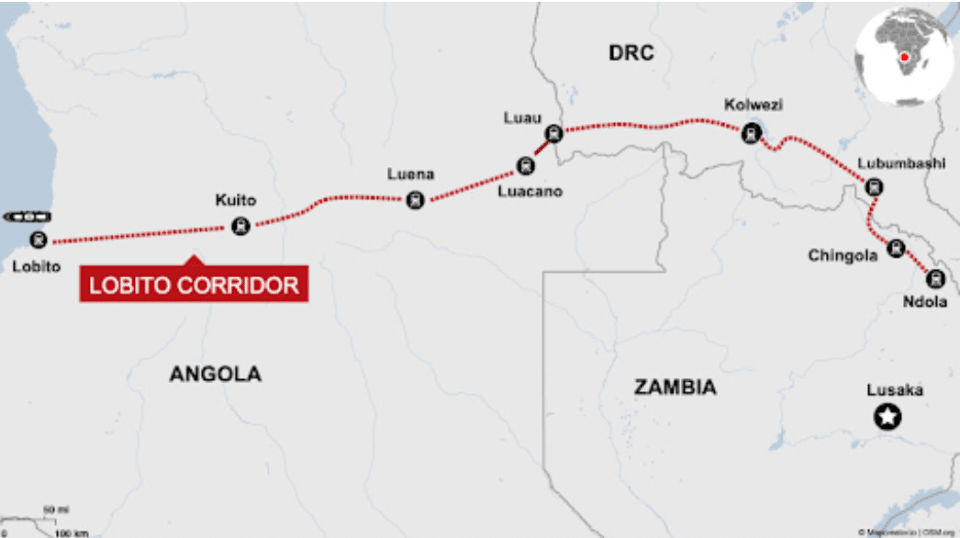


Zambia has announced it would increase the reach of a US$491 million programme of grants by the United States to boost infrastructure in the country to support the Lobito Corridor, further solidifying its ambition to become a major transport and logistics hub for Southern and Central Africa. The new funding structure will now also include finance for infrastructure for both the agricultural industry and the developing critical mineral industry in Zambia, a testament to the growing strategic significance of multimodal transport corridors in the region for trade.
The grant, called the Millennium Challenge Corporation’s (MCC) Farm-to-Market Compact, was initially signed in 2024 to boost agricultural productivity by delivering better rural transportation and market access. The new agreement includes funding for infrastructure projects that also support the transport of critical minerals, which will help to establish an integrated transport network that supports two of Zambia’s most important economic sectors.
The realignment would be aimed at improving economic activity along the Lobito Corridor, which is becoming one of the biggest economic and logistics corridors in Africa, says Zambia’s Ministry of Finance and National Planning. The ministry said the new programme will boost infrastructure to aid agricultural production and enhance logistics for the growing mining sector in Zambia, especially the Copperbelt and North-Western provinces.

The Lobito Corridor is gaining importance as a trade route between Zambia and the Democratic Republic of the Congo, and the Port of Lobito on the Atlantic coast of Angola, as it is increasingly developed as a railway corridor. When complete, the corridor will offer a quicker and more efficient pathway for copper, cobalt and other vital minerals being more and more vital to electric vehicles, battery manufacturing and renewable energy technologies, all of which are in increasing demand globally. The corridor will also help to lower transport costs, boost export competitiveness and diversify mineral-producing nations’ export corridors in the region.
The reform of the grant is significant for transport and logistics in Zambia, not just as an investment in infrastructure, but as a step toward a more sustainable future. It will enhance road connectivity to the Lobito Corridor; enhance freight logistics between the mining areas and the export terminals; and establish more efficient logistics networks, which will support both agricultural products and mineral exports. Better transport connectivity will also help to build up the reliability of the transport corridor, lessen transit times and allow for more cargo to travel through the corridor.

The Minister of Finance has confirmed that the priority road rehabilitation projects are already aligned to the Lobito Corridor development strategy. Certain strategic roads have been identified in the Copperbelt and North-Western provinces to be upgraded to enhance road connectivity to production centres, mining operations, border crossings and rail infrastructure. These investments will likely contribute significantly to the development of regional trade, as well as to the efficiency of logistics services for exporters and freight operators.
Further, the revised agreement is part of Zambia’s new approach of multi-sectoral integration of infrastructure planning to achieve maximum economic impacts. The government’s initiative to integrate agriculture with the mining transport system promises a more robust and efficient freight system that will better serve future industrial development and regional trade integration.
The momentum of the Lobito Corridor is growing as governments, development finance institutions and private investors step up their support for the project. Leading developer of the Lobito Corridor railway, the African Finance Corporation, is set to achieve financial close this quarter in Q4 2027, which will move the region closer towards delivering one of Africa’s most important transport and logistics corridors. The corridor will evolve over time to influence trade flows throughout Southern and Central Africa, while opening up new opportunities for logistics providers, transport operators, infrastructure developers and supply chain investors.



