

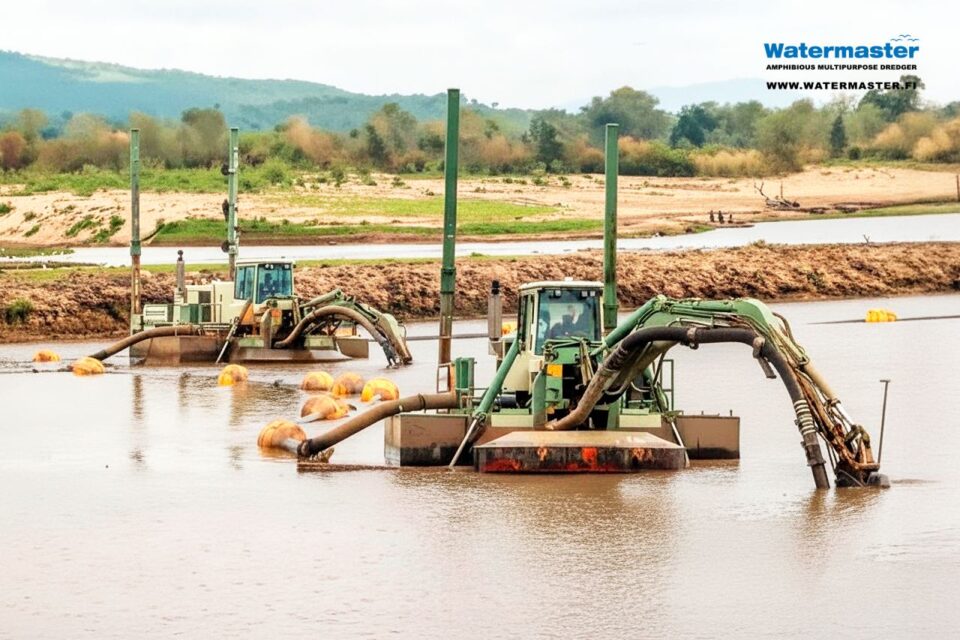


Zambia is turning to a more flexible approach to maintaining its extensive network of rivers, lakes and canals, with the Ministry of Transport and Logistics using Watermaster amphibious machines to support waterway maintenance and improve access to critical transport infrastructure.
With thousands of kilometers of waterways across the country, Zambia faces a range of maintenance challenges. Sediment can build up and reduce waterway depth, invasive aquatic vegetation can obstruct navigation, while reservoirs can gradually lose capacity because of silt accumulation. Traditionally, addressing these problems could require different types of specialized machinery, creating additional costs for transportation, operators and maintenance.

The Watermaster fleet offers the ministry a single-machine solution capable of performing several tasks.

The machines can be used for dredging, excavation, aquatic vegetation clearance and pile driving. This versatility allows the ministry to deploy the same equipment for different projects instead of moving specialized machinery over long distances whenever the nature of a job changes.
For Zambia’s transport and logistics sector, the approach can provide an important operational advantage. Watermasters can be positioned in different parts of the country and deployed to areas where work is required. A machine already operating in one location can be reassigned to another task without requiring additional heavy equipment to be brought in from elsewhere.


The fleet can also support both planned and emergency maintenance. Routine dredging and vegetation removal can help keep waterways operational, while machines can be dispatched to urgent locations where blocked waterways could contribute to flooding or disrupt movement.
Another feature is the machines’ ability to launch, move and anchor independently without cranes or support vessels. This gives operators greater flexibility when working in shallow or difficult-to-access areas where conventional dredging equipment may struggle to operate.
The capability is particularly relevant to Zambia as the country continues to explore ways of improving transport connectivity and making better use of its inland waterways. Efficient waterways can support the movement of people and goods, while regular maintenance helps reduce disruptions and preserve infrastructure.

By using a multipurpose fleet rather than relying on several specialized machines, the Ministry of Transport and Logistics can simplify equipment deployment and maintenance while potentially reducing the cost and logistical complexity associated with waterway projects.
For Zambia, the Watermaster approach represents more than a dredging solution. It provides a flexible piece of infrastructure-support equipment that can be moved between projects and adapted to changing maintenance requirements, helping the country keep its waterways accessible, functional and safer for communities and transport users.

