

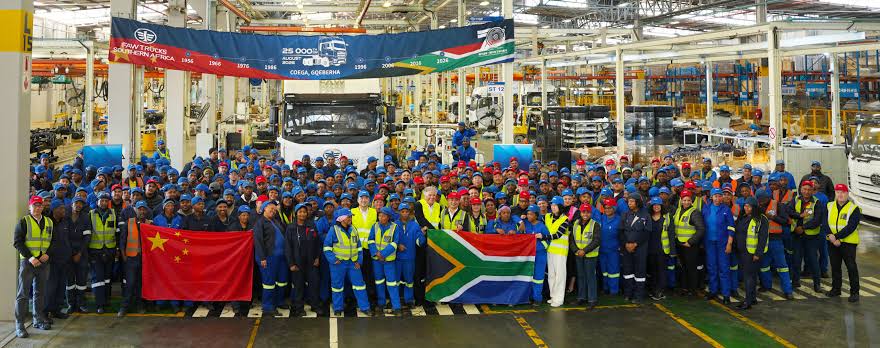


FAW Trucks Southern Africa (FTSA) has reached a major milestone, celebrating the 25,000th truck rolling off the assembly line at its manufacturing plant in Nelson Mandela Bay. This accomplishment underscores not only the company’s remarkable growth but also its deep-rooted commitment to the South African market and its local manufacturing capabilities.
The journey began in 1994, a pivotal year in South Africa’s history that not only changed the political landscape but also laid the groundwork for the commercial vehicle manufacturing industry. In July 2014, FAW Trucks achieved a major milestone by producing its first local freight carrier within the Coega Special Economic Zone. This was more than just a production event; it demonstrated FAW’s confidence in local expertise and the broader concept of China-Africa collaboration in industry. Fast forward to August 2026, the assembly plant produced its 25,000th unit—a significant achievement that reflects 32 years of dedicated product development and over a decade of localized assembly.
This rapid production growth, moving from a mere 1,000 units in 2014 to a remarkable 25,000 by mid-2026, is a testament to its increasing acceptance and the evolving landscape of the South African freight transport sector. The last three years have brought a notable acceleration in production, driven primarily by South African fleet operators who are increasingly prioritizing the total cost of ownership. This includes not just the initial purchase price but also considerations such as fuel efficiency, maintenance costs, and overall support coverage—factors that have catapulted FAW’s demand, particularly for its heavy-duty models. The JH6 model, in particular, has carved out a niche for FAW in the highly competitive extra-heavy truck market. Furthermore, the anticipated launch of the new generation J7 28.550FT in March 2026 promises to introduce superior technological features, potentially enhancing FAW’s appeal and competitive edge in the industry.

The Coega manufacturing facility, which initiated operations in 2014 with a substantial investment of R600 million from the China FAW Group and the China-Africa Development Fund, stands as one of the largest Chinese industrial investments in South Africa to date. Not only does it symbolize the integration of foreign investment into local infrastructure, but it also plays a pivotal role in supporting local economic development by focusing on training and the employment of South African talent.
As part of its ongoing commitment to growth, FAW has allocated an additional R200 million to expand the plant’s production capacity from an annual output of 5,000 to 8,000 units by 2028. This expansion is accompanied by substantial investment in human capital; approximately 2,500 individuals have undergone training at the site. FAW Trucks is dedicated to bolstering industrial employment and fostering skills development in the Nelson Mandela Bay area, while also meeting domestic market needs and export demands across the Southern African region.

To its customers, FAW Trucks stands for a proven record of reliability, durability, and quality—hallmarks that have helped build a loyal customer base. For dealers, the brand offers dependable local supply chains and shorter lead times, enhancing operational efficiency. Meanwhile, the local workforce in Gqeberha benefits from skilled employment opportunities in the commercial vehicle manufacturing sector, further contributing to the region’s economic development.
In the broader context, FAW Trucks is a dynamic, fast-growing business that has earned trust and sustained growth in the competitive South African market. Its South African operations have escalated into a strategic manufacturing hub, contributing substantially to the global milestone of 70,000 truck roll-offs.
As production capacity expands and export demand increases, FAW Trucks Southern Africa views reaching 25,000 units as a foundational step toward future growth. With a solid operational framework already in place, the company is well positioned for continued success, with a continued commitment to making a lasting impact on the South African economy and the freight transport landscape.



